Quick answer
Tattoos tend to hurt most where the skin is thin, sits close to bone or has lots of nerve endings: the ribs, spine, head and neck, hands and wrists, elbows, knees, shins, and feet and ankles. They tend to hurt least where there is more padding: the outer upper arm and shoulder, forearm, chest, back, outer thigh and calf. Session length and stress make a difference too.
Every tattoo hurts a little, but where it goes makes a real difference to how it feels. Below is a front and back pain chart, a table of each body area and why it sits where it does, and what a study of more than 1,000 tattooed people found about what makes a session harder or easier. If you are planning your first, our first tattoo guide covers the rest of the preparation.
Tattoo pain chart
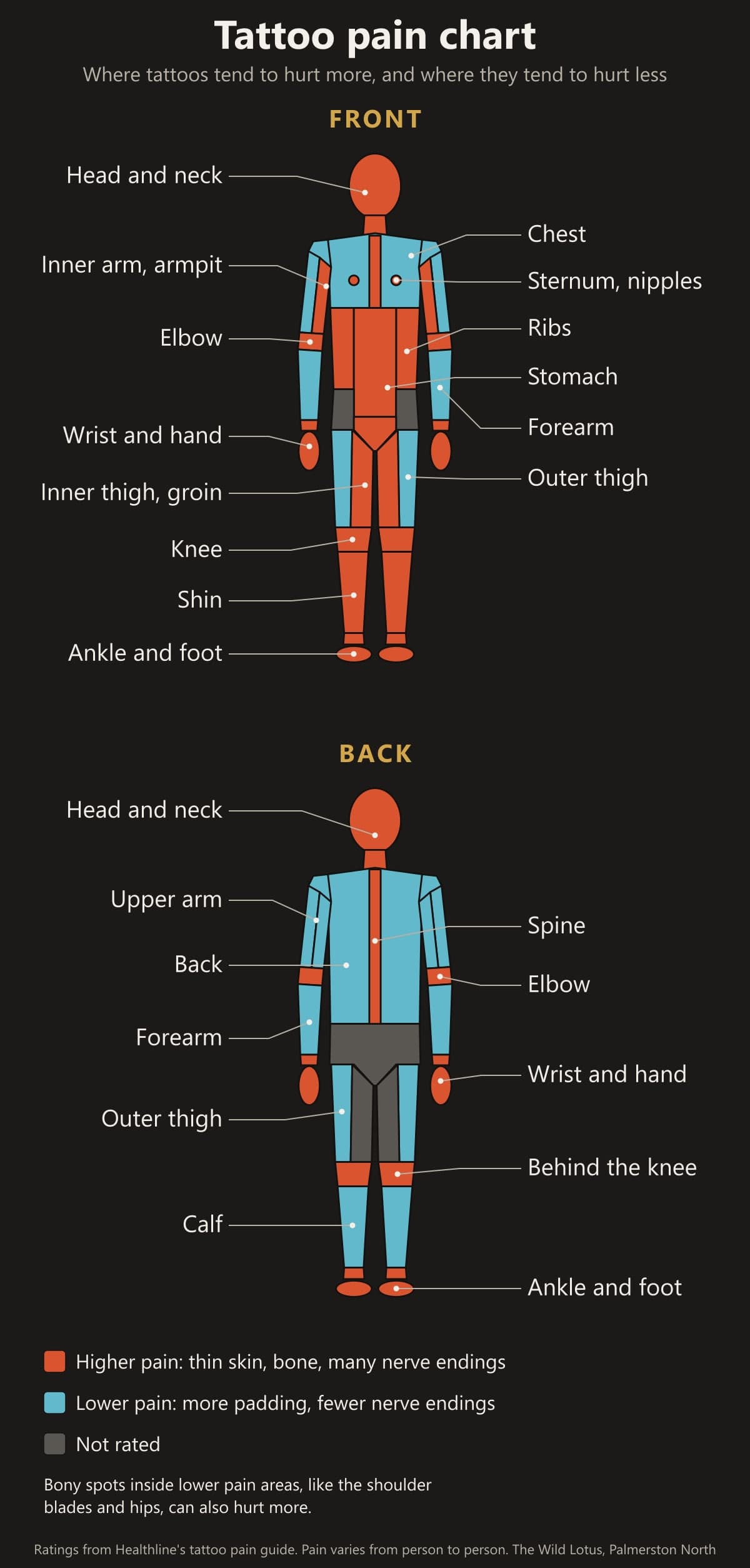
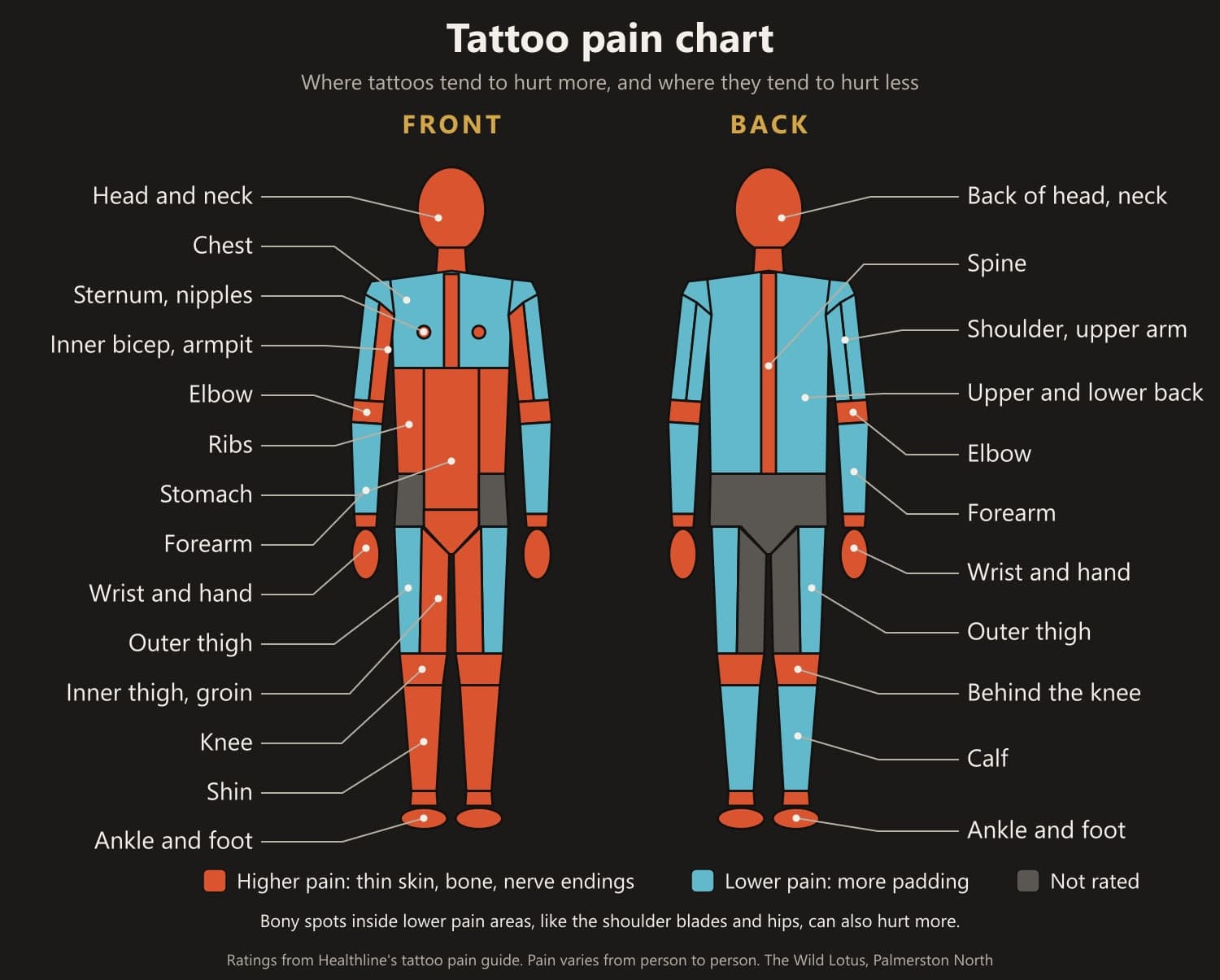
The pattern behind the chart is simple. According to Healthline, the least painful places have the most fat, the fewest nerve endings and the thickest skin, and the most painful have the least fat, the most nerve endings and the thinnest skin. Bony areas usually hurt a lot, because there is little between the needle and the bone. That is why the breastbone is marked red in the middle of a lower pain chest.
Not every red area hurts equally, and blue does not mean painless. A long, heavily shaded session in a lower pain area can still be hard going, because session length is one of the biggest factors in how much a tattoo hurts.
Tattoo pain by body part
| Body area | Pain level | Why |
|---|---|---|
| Head, face and neck | Higher | Thin skin over bone, with many nerve endings |
| Spine | Higher | Bone sits just under the skin along its whole length |
| Ribs | Higher | Thin skin and little padding over the rib bones |
| Armpit and inner bicep | Higher | Soft, thin skin with many nerve endings |
| Elbow | Higher | Bone close to the surface on the outside, thin skin on the inside |
| Wrist, hands and fingers | Higher | Many nerve endings and very little padding |
| Breastbone (sternum) | Higher | Bone sits just under the skin, with little padding |
| Nipple and areola | Higher | Very sensitive skin with many nerve endings |
| Stomach | Higher | Varies with body type. Looser skin tends to be more sensitive |
| Groin and inner thigh | Higher | Thin, sensitive skin with many nerve endings |
| Knee, and behind the knee | Higher | Bone at the front, thin and sensitive skin behind |
| Shin | Higher | Thin skin directly over the shin bone |
| Ankle, feet and toes | Higher | Bone close to the surface and very little padding |
| Outer upper arm and shoulder | Lower | More muscle and padding, fewer nerve endings |
| Forearm | Lower | Muscle and padding, especially on the outer side |
| Chest, away from the breastbone | Lower | Muscle and padding over the upper chest |
| Upper and lower back | Lower | Thick skin and padding, away from the spine. Bony spots like the shoulder blades can hurt more |
| Outer thigh | Lower | Plenty of muscle and padding |
| Calf | Lower | Muscle and padding, away from the shin bone |
Two things the table cannot show. The edges of an area matter: a forearm piece that wraps onto the inner wrist, or a back piece that runs over the spine, will have higher pain moments even in a lower pain area. And everyone is different, so treat the chart as a guide to what most people find, not a promise.
Same time, different spot: two real pieces
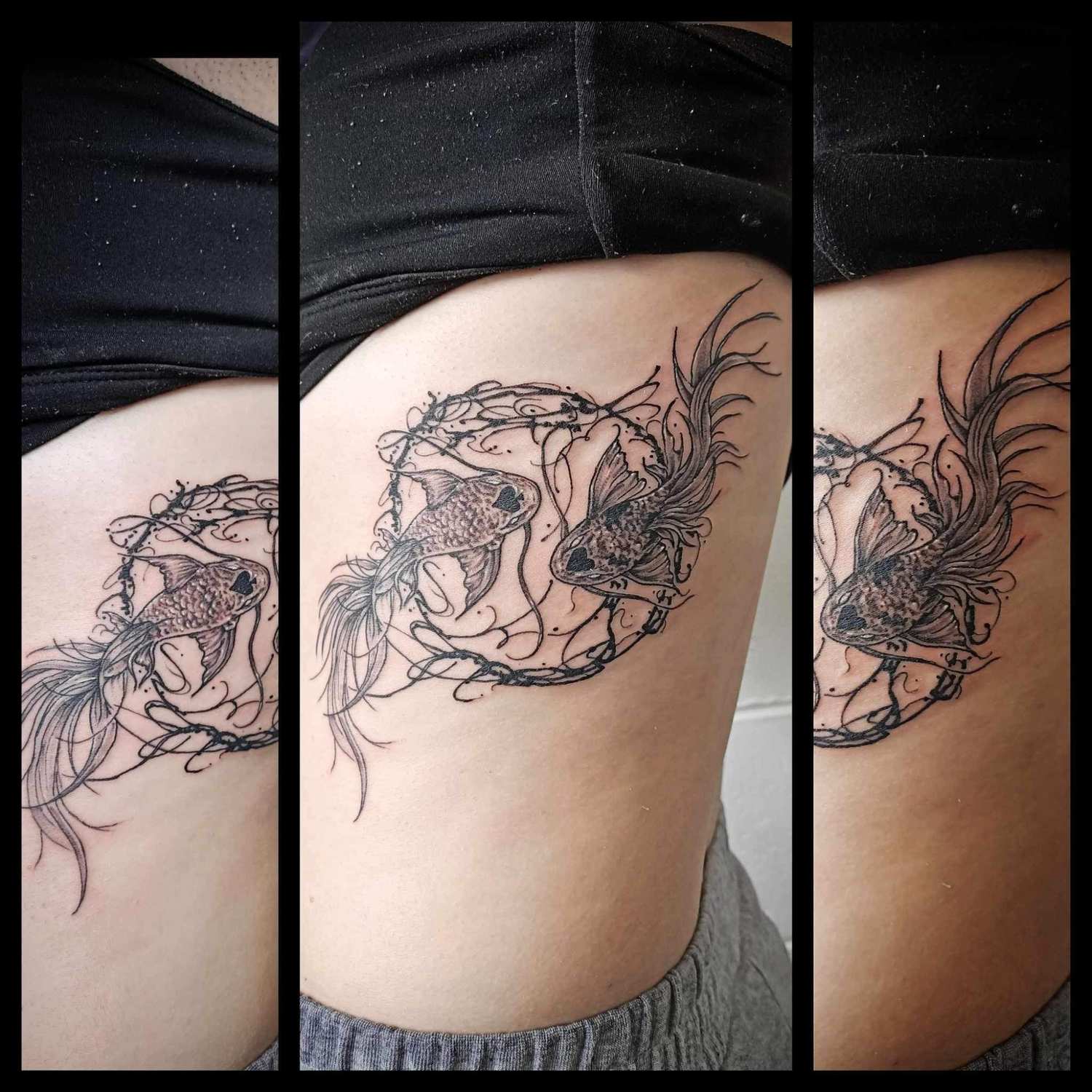
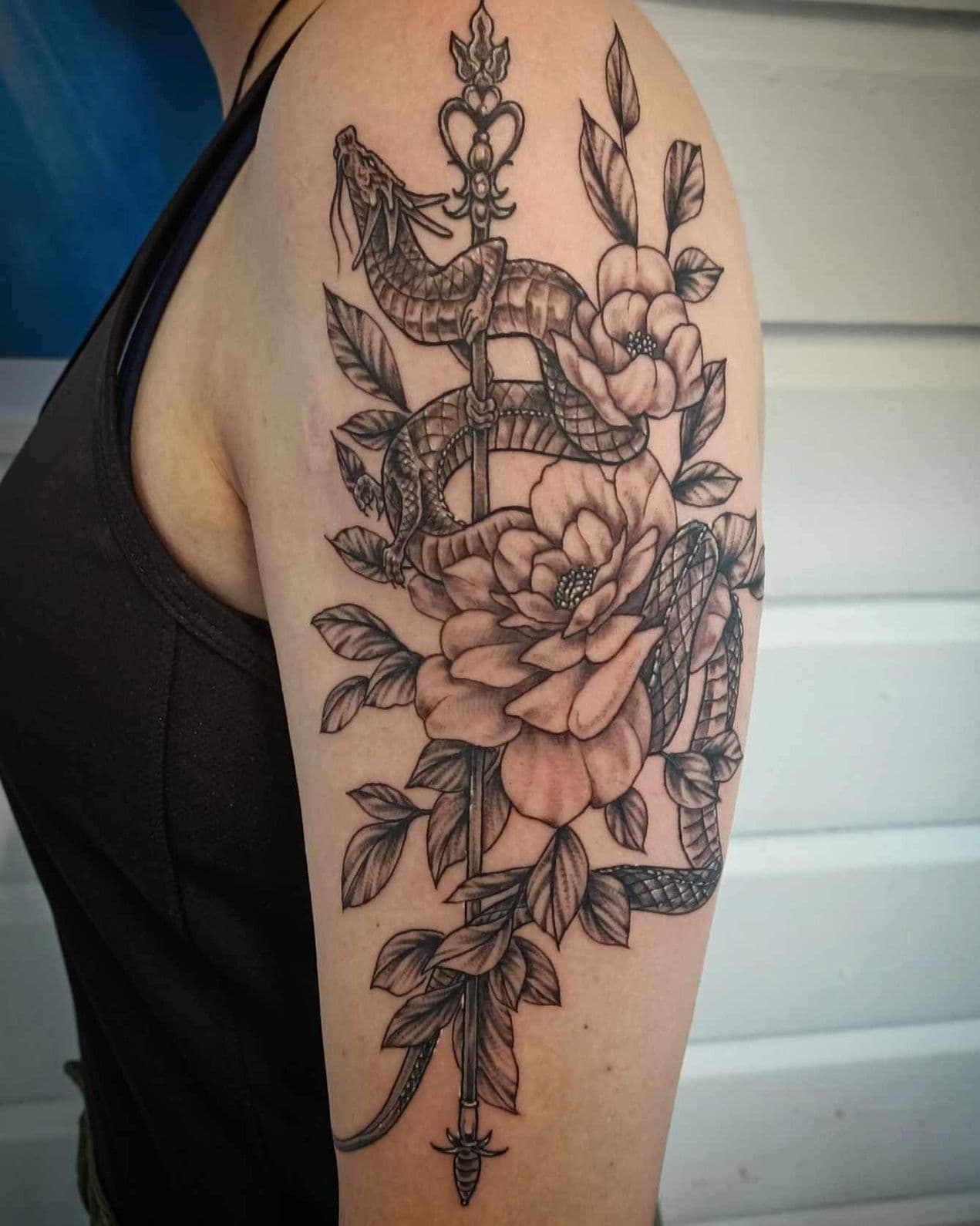
These two pieces from our Palmerston North studio each took about 4 hours, so the session length was the same. What changes is where they sit on the chart. You can see what each one cost in our pricing guide.
Koi fish on the ribs
- Placement
- Ribs
- On the chart
- Higher pain
- Approx. time
- 4 hours
Two koi fish swimming in a circle along the side of the ribs, in fine line, a pair that usually stands for balance, as our guide to koi fish tattoo meaning explains. The ribs are one of the higher pain areas on the chart, because the skin is thin and there is little padding over the bone.
If you have your heart set on a rib piece, it is very doable. It is worth planning for, though: a good night's sleep, a proper meal beforehand, and a design that suits a session you are comfortable with.
Snake and dagger on the upper arm
- Placement
- Upper arm
- On the chart
- Lower pain
- Approx. time
- 4 hours
A snake coiled around a dagger with peonies, running down the outer upper arm in black and grey. The outer upper arm is one of the lower pain areas, with more muscle and fewer nerve endings than the inner arm.
What makes a tattoo hurt more: what the research says
The largest study we have found on this asked 1,092 people in Poland to rate their tattoo pain on a 0 to 10 scale, during the tattoo and straight afterwards. Published in 2020, it looked at what made the biggest difference. The factors that most increased pain during tattooing were:
- Session length. The longer the tattoo took, the more it hurt, both during the session and afterwards.
- Bleeding. People who bled more reported more pain. Every tattoo bleeds a little, but how much varies.
- Stress. The more stressed people felt beforehand, the more pain they reported.
- Painkillers taken beforehand. People who took pain medication before their tattoo reported more pain, not less. The study cannot say why, but it is a good reason not to rely on painkillers to get you through.
The same study found that pain spreading beyond the tattooed area was more common for tattoos on the arms than on the legs. The authors suggest this may come down to how densely nerve endings are packed in different parts of the body.
Do tattoos hurt more for women?
Not during the tattoo, according to that study. It found no difference between women and men in pain during tattooing. Women did report more pain straight afterwards. The women in the study also reported more stress beforehand, and more often chose the torso, so a calm run-up and a well chosen placement matter for everyone. There is no separate pain chart for women: the chart above applies to every body.
How to make your tattoo hurt less
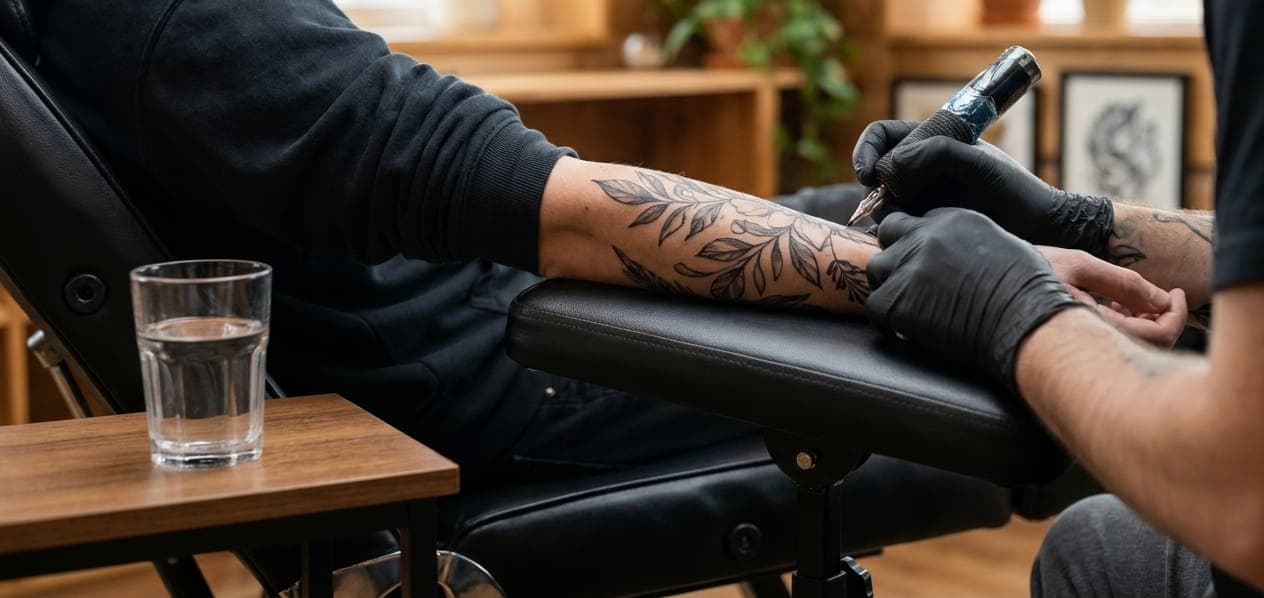
Small things that make a real difference
Most of what makes a session easier is in your hands before you sit down. Healthline recommends staying hydrated, limiting caffeine, avoiding alcohol beforehand, and keeping yourself distracted during the tattoo.
- Pick your placement with the chart in mind, especially for a first tattoo. Talk it through with your artist, who can tell you where your design will hurt more or less.
- Keep sessions to a sensible length. Longer sessions hurt more, so for a big piece, ask whether it can be split across more than one sitting.
- Sleep well and eat a proper meal beforehand. Our first tattoo guide covers what to eat, drink and bring.
- Skip alcohol, keep caffeine low and drink water.
- Bring a distraction. Headphones with music or a podcast, or someone to talk to.
- Lower the stress before the day. Visit the studio, meet your artist and ask every question you have. Walk-ins are welcome at our studio, so you can come and have a look first.
- Breathe slowly and ask for breaks. A short pause to stretch and have a drink is normal.
- Ask your artist before using a numbing cream. Healthline suggests talking through your options with your artist, who can advise on whether and how to use one.
If you have a health condition, such as diabetes, Health New Zealand advises talking to your healthcare provider before getting tattooed, and asking them which pain relief to take afterwards if you are unsure. Once it is done, our tattoo aftercare guide and healing timeline cover what comes next.
Planning a tattoo in a higher pain spot?
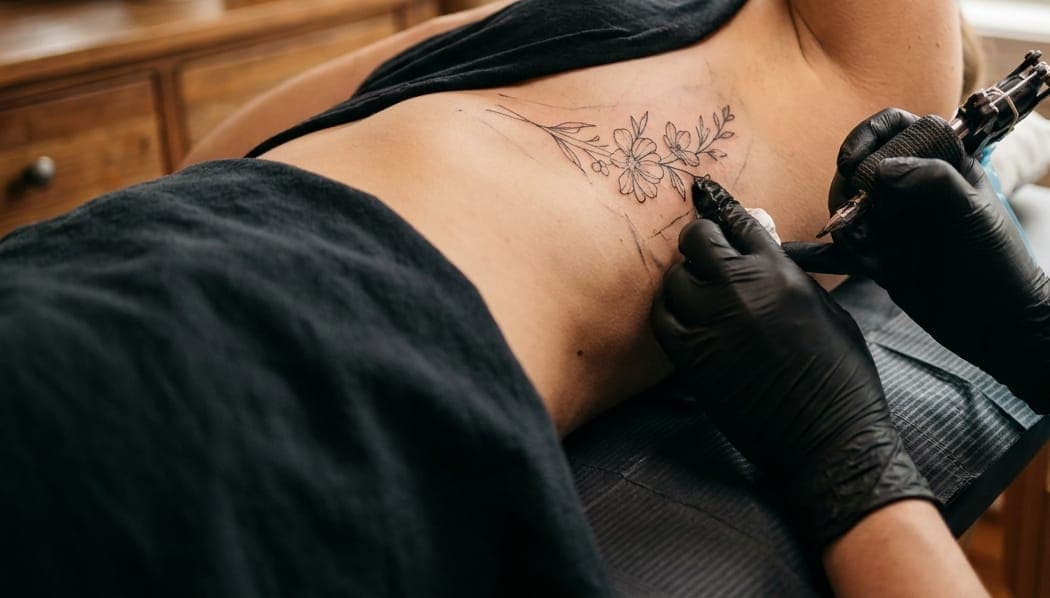
Ribs, spine, feet and hands are still very doable
A higher pain area is not a reason to give up on the placement you want. It is a reason to plan: a design and size that suits a comfortable session, a calm run-up, and an artist who will go at your pace.
If you are weighing up where to put your next piece, have a look through our gallery and the styles we tattoo, then send us your idea and placement. We will talk it through with you before anything begins.
Frequently Asked Questions
Where is the most painful place to get a tattoo?
The most painful places are usually where skin is thin, close to bone or packed with nerve endings: the ribs, spine, head and neck, armpit, elbows, hands and fingers, knees, shins, and feet and ankles. Healthline rates these as high to severe pain, though how much any spot hurts varies from person to person.
Where is the least painful place to get a tattoo?
The least painful places have more padding and fewer nerve endings: the outer upper arm and shoulder, forearm, chest, back, outer thigh and calf. Healthline rates these as low to moderate pain, which makes them a gentle place to start if you are nervous about a first tattoo.
Do tattoos hurt more for women?
Not during the tattoo. A 2020 study of 1,092 tattooed people found no difference between women and men in pain during tattooing. Women reported more pain straight afterwards, and also more stress beforehand. The same pain chart applies to everyone.
Do rib tattoos hurt?
Yes, the ribs are one of the higher pain areas, because the skin is thin and there is little padding over the bone. Rib tattoos are still very common and very doable. Plan for a session length you are comfortable with, sleep well, eat beforehand and bring a distraction.
Does a tattoo hurt more the longer it takes?
Yes. In a 2020 study of 1,092 tattooed people, the time a tattoo took was one of the factors that most increased pain, both during the session and afterwards. For a large piece, ask your artist whether it can be split across more than one session.
Should I take painkillers before a tattoo?
It is worth not relying on them. In a 2020 study of 1,092 tattooed people, those who took pain medication beforehand reported more pain during tattooing, not less. If you are unsure what pain relief to take for aftercare, Health New Zealand advises asking your healthcare provider.
Can I use numbing cream for a tattoo?
Talk to your artist before you put anything on your skin. Healthline suggests discussing numbing cream options with your tattoo artist, who can advise on whether one suits your tattoo and how to use it. Do not apply one on the day without checking first.
Sources
- Healthline: Guide to tattoo pain by body part and what to expect (medically reviewed, updated December 2024)
- Witkoś and Hartman-Petrycka (2020), Gender differences in subjective pain perception during and after tattooing, International Journal of Environmental Research and Public Health
- Health New Zealand | Te Whatu Ora: Tattoos
General information only, not medical advice. If you are worried about your healing, contact your doctor or call Healthline free on 0800 611 116, any time.